LoraWAN
LoraWAN architecture
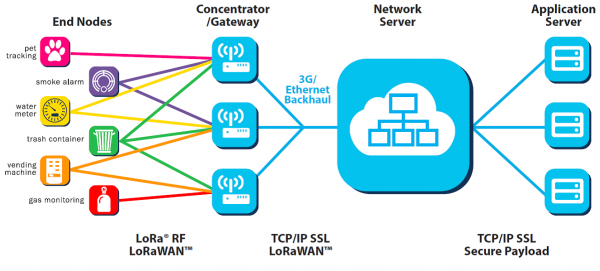
LoraWAN architecture
In the above architecture, there are mainly three types of devices. They are end nodes, concentrator/gateway and network server.
- End nodes - The end nodes are the sensor/iot devices. They maybe pet tracking, vending machine, gas monitoring etc.
- Concentrator/gateway - This is the relay between the end nodes and the network server that transfers the data from the end nodes to the network server and vice versa.
- Network server - This is the target destination to which the end nodes wants to transfer its data to.
The communication between end nodes and the concentrator/gateway uses RF(radio frequency). The communication between the concentrator/gateway uses 3G/Ethernet.
Classes of Lora
- Class A - Lowest power, bi-directional end-devices: The default class which must be supported by all LoraWAN end-devices, class A communication is always initiated by the end-device and is fully asynchronous. Each uplink transmission can be sent at any time and is followed by two short downlink windows, giving the opportunity for bi-directional communication, or network control commands if needed. This is an ALOHA type of protocol. The end-device is able to enter low-power sleep mode for as long as defined by its own application: there is no network requirement for periodic wake-ups. This makes class A the lowest power operating mode, while still allowing uplink communication at any time. Because downlink communication must always follow an uplink transmission with a schedule defined by the end-device application, downlink communication must be buffered at the network server until the next uplink event.
- Class B – Bi-directional end-devices with deterministic downlink latency: In addition to the class A initiated receive windows, class B devices are synchronised to the network using periodic beacons, and open downlink ‘ping slots’ at scheduled times. This provides the network the ability to send downlink communications with a deterministic latency, but at the expense of some additional power consumption in the end-device. The latency is programmable up to 128 seconds to suit different applications, and the additional power consumption is low enough to still be valid for battery powered applications.
- Class C – Lowest latency, bi-directional end-devices: In addition to the class A structure of uplink followed by two downlink windows, class C further reduces latency on the downlink by keeping the receiver of the end-device open at all times that the device is not transmitting (half duplex). Based on this, the network server can initiate a downlink transmission at any time on the assumption that the end-device receiver is open, so no latency. The compromise is the power drain of the receiver (up to ~50mW) and so class C is suitable for applications where continuous power is available. For battery powered devices, temporary mode switching between classes A & C is possible, and is useful for intermittent tasks such as firmware over-the-air updates.
LoraWAN Specifications
- Standard: LoRa WAN technology follows IEEE 802.15.4 standard
- Frequency: License free ISM bands 433, 868, 915 MHz
- Bandwidth: 125 KHz, 250 KHz and 500 KHz
- Modulation: Chirp spread spectrum based modulation (suitable for better sensitivity)
- Data rate: Up to 50 kbps
- Range: Up to 20 KM
What is Lora Gateway?
Lora gateway is a sophisticated software architecture designed to carry out communication in Lora network terminology. It acts as a smart hub between end devices and application network server. In future, it will be preinstalled on all IoT enabled hardware to support wide range of applications.
Advantages of LoraWAN
- Long battery life for devices and sensors due to low power consumption
- Low cost implementation due to low cost hardware and unlicensed spectrum
- Long range coverage and in-building penetration
- Less complexity in programming
- Offers a secure transmission network
- Scalable network to support future upgrades
- Ease of access and connectivity to the cloud applications
- Remote management and control access
- Highly intelligent architecture
Future scope
In future, our global, national and regional networks have to support billions or even trillions of devices. LoRa can play a significant role for providing a smart, low cost and highly efficient network for future applications. It has an association of more than 400 companies globally to contribute, improve and implement smart network for future needs.